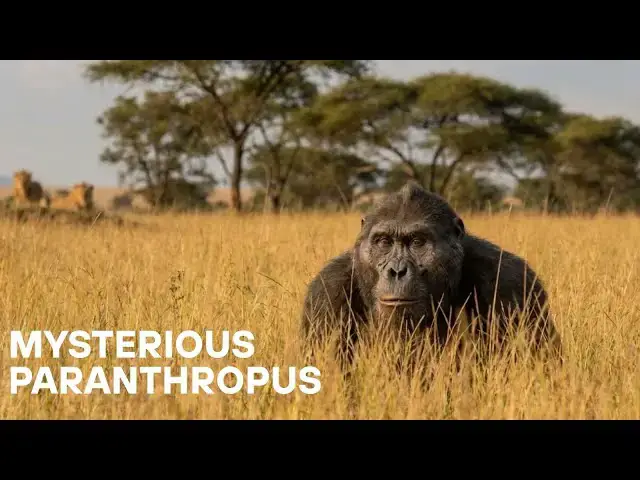

What Really Happened to Mysterious Paranthropus boisei?
Dec 14, 2025

The human evolutionary tree contains "side branches" that existed alongside our direct ancestors but eventually went extinct. One such significant branch emerged around 3 to 2 million years ago due to global cooling that transformed Africa into harsher, more arid environments. Two major hominin lineages arose to face these challenges: the genus Homo (our ancestors) and their robust rivals, the genus Paranthropus.
Flourishing in Africa between 2.7 and 1.2 million years ago, Paranthropus species are known as "robust australopithecines" due to highly specialized anatomy designed for powerful chewing. This is evident in their skulls, which feature broad, dish-shaped faces, flaring cheekbones to accommodate large muscles, and prominent sagittal crests for muscle attachment. Their dentition is characterized by massive molars with thick enamel and relatively small front teeth, reinforced mandibles, and deep dental arcades—all adaptations for processing tough, fibrous foods.
Below the neck, they were bipedal with moderate body size and significant sexual dimorphism, though not adapted for the long-distance walking seen in later Homo. Interestingly, recent analysis suggests Paranthropus hands were capable of powerful gripping and potentially simple tool-making, challenging the idea that only Homo used tools. However, their hands lacked the "precision pinch" necessary for fine manipulation, suggesting their powerful grip evolved primarily for ripping tough vegetation.
The Paranthropus Species and P. boisei The text details three main species:
** P. ethiopicus (2.7–2.3 MYA, East Africa):** The earliest known species and likely ancestor to later groups.
** P. robustus (2–1.2 MYA, Southern Africa):** A separate southern evolutionary branch.
** P. boisei (2.3–1.2 MYA, East Africa):** The later, most well-known species, nicknamed "Nutcracker Man" because it exhibited the most extreme chewing adaptations of the entire group.
Paranthropus boisei is confirmed as an evolutionary side branch, evolving from P. ethiopicus, and was not an ancestor to modern humans. It lived parallel to early Homo species for over a million years, representing a contrasting survival strategy: while Homo evolved dietary flexibility, tool use, and larger brains, P. boisei became progressively more specialized for a narrow ecological niche.
Diet, Niche, and Extinction Evidence indicates P. boisei maintained a remarkably consistent, herbivorous diet dominated by C4 plants (grasses and sedges). Its massive jaws were likely adaptations not just for everyday feeding, but for processing tough "fallback foods" during times of scarcity. This specialized niche was durable, allowing the species to thrive for a million years.
The text challenges the traditional view that P. boisei was driven to extinction by direct competition with the more advanced, tool-using Homo. Instead, new evidence suggests its demise was caused by ecological inflexibility during a period of climate instability known as the Mid-Pleistocene Transition.
Show More Show Less #Science
#Biological Sciences
#Ecology & Environment